Buying makeup online meant guessing. My Makeup Artist let customers see how a shade looked on their own face — before they bought it.
Foundation, lipstick, concealer — buying these products online required a leap of faith that most shoppers weren't willing to take. The result was high browse rates and low conversion. Customers would research in-store and buy in-store, or not at all.
My Makeup Artist used facial recognition and augmented reality to put a virtual try-on experience inside the product page itself — turning a moment of uncertainty into a moment of confidence.
The technology existed. The trust didn't.
Early virtual try-on tools were technically impressive and experientially terrible — uncanny valley rendering, slow load times, and shade matching that was wrong often enough to make people distrust it completely. The design had to earn trust within the first ten seconds or users would dismiss it as a gimmick.
Internally, there was no precedent. Coty had never shipped an AI consumer product. Building the business case required modelling conversion uplift from scratch, presenting to brand directors who were worried about losing creative control, and a tech team that had never shipped AR to consumers at this scale.
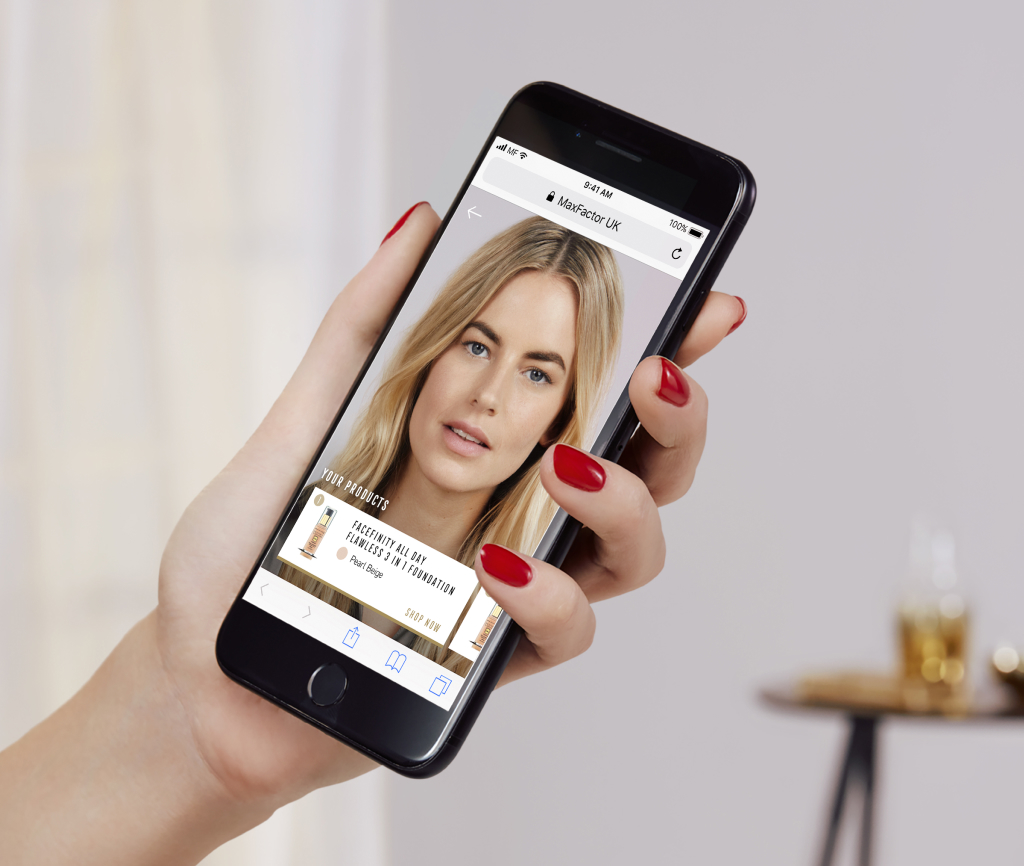
Users could scan their face, see the product on their skin in real time, get a personalised recommendation, and add to cart — without leaving the product page.
The end-to-end flow had four moments: face analysis, shade matching, live try-on, and recommended products. Each had to feel like one coherent experience, not four separate features strung together. The quality of the transitions — and the speed — determined whether it felt like technology or magic.
We ran four rounds of user testing before launch, iterating primarily on the confidence signals: how the app communicated what it was doing, and why the user should trust its output. Delightful wasn't enough. It had to be credible.
I had to convince two different organisations — the brand team and the tech team — that the other one wouldn't break what they'd built.
Brand directors wanted the rendering to be flattering. Engineers wanted it to be accurate. These are not the same thing, and the gap between them is where most AI beauty products fail. I created a shared quality framework — agreed by both sides — that defined what "good enough" looked like before a single line of code was written.
Getting sign-off required building the full business case from scratch: user research, competitor benchmarking, conversion modelling. I presented to Coty Digital leadership and secured budget for a product category the company had never touched.
My Makeup Artist won the Webby Award in 2020 for Best App, Mobile & Voice in Fashion, Beauty & Lifestyle — and was a Drum DADI Award finalist for Technical Innovation.
The product launched across four Coty brands and demonstrated that AI-powered try-on could meaningfully move conversion numbers when the experience was designed to earn trust, not just demonstrate capability. It helped establish Coty Digital's case for further investment in AI consumer tools.
Winning a Webby confirmed something we already knew from the user testing: the technology only worked because we spent months on the emotional design, not the technical one.
The AI was a means to an end. The end was a woman standing in her kitchen, on her phone, who believed for the first time that she could buy a foundation online without regretting it. Everything we designed was in service of that moment of belief.