
Brand managers could log in on a Monday morning, see which campaign needed budget moved, and act on it before the window closed.
Booster was a real-time social advertising platform built for Coty's brand portfolio. It ingested live performance data from paid social campaigns — Rimmel, Max Factor, Wella, Covergirl and others — assessed each campaign against a success criterion, and surfaced a single, actionable recommendation: where to move the budget, right now.
Before Booster, that decision took a week. Managers exported data from five platforms, reconciled formats in spreadsheets, and presented recommendations in a meeting that had already missed the moment.
The problem wasn't a lack of data. It was data that arrived too late, in too many formats, to act on.
Every brand had its own tooling, its own reporting cadence, and its own definition of what good performance looked like. Getting four brand teams to agree on a shared success criterion — before designing a single screen — was the core design challenge. Not the UI. The definition.
Booster didn't arrive as a finished brief. I spent the first phase running working sessions with brand managers and data analysts to map what "a good campaign" actually meant in practice — and where those definitions diverged across Rimmel, Max Factor, and Wella.
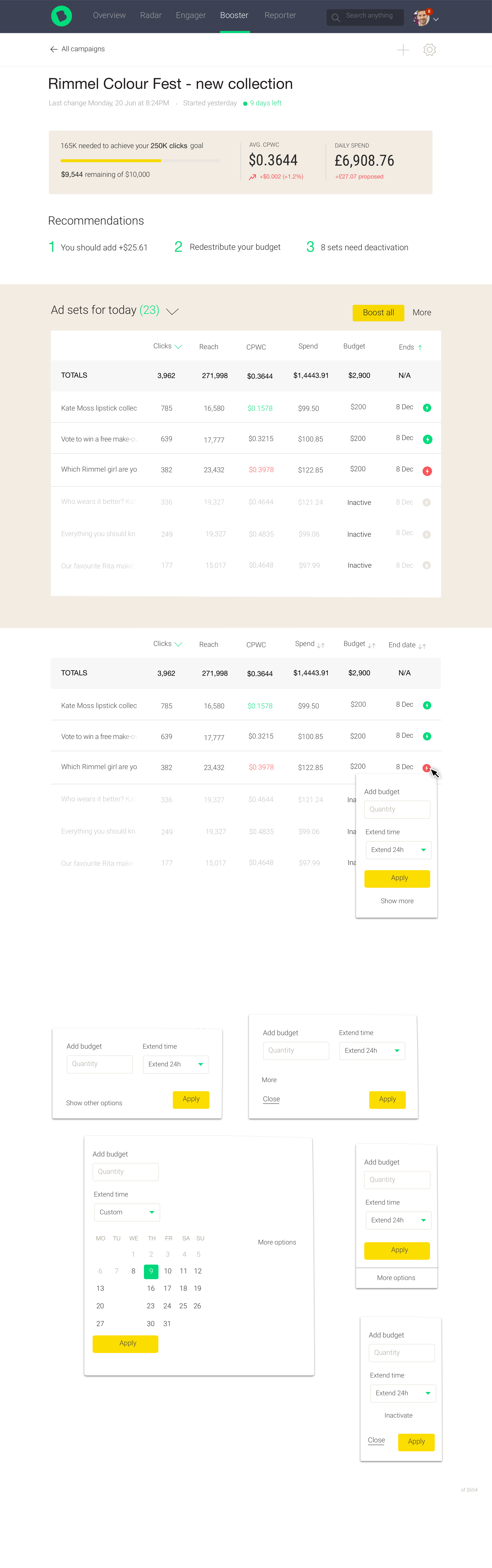
Three surfaces — Ad Composer, Campaign Analysis, and a mobile-first dashboard — designed as one product.
The Ad Composer let managers create multiple ad variants without switching tools. The Campaign Analysis dashboard surfaced the single most important insight: which campaign was underperforming against its own target, and by how much. The mobile interface meant a brand manager could act on a budget shift from their phone, in a meeting, before the opportunity passed.
The key design decision was hierarchy. The recommended action — move budget here — was always the most prominent element on screen. Analytics were context, not the point. The point was the decision.
The alignment work took three months. The design took six weeks.
Getting four brand teams to agree on what "success" meant required mapping every team's workflow, surfacing where they differed, and translating those differences into product principles that everyone could sign off on. Without that foundation, we'd have built a dashboard that satisfied nobody.
The discovery phase — auditing workflows, running sessions, mapping definitions — is work that often gets compressed or skipped. On Booster, it defined everything that came after.
Booster launched across four Coty beauty brands and remained operational after Beamly's integration into Coty's digital infrastructure.
The platform demonstrated something broader: that brand managers didn't need more data — they needed permission structures and clear recommendations that made it safe to act quickly. That insight shaped how Coty thought about its internal tooling for years after the project shipped.
The dashboard was a red herring. What brand managers actually needed wasn't better data — it was the organisational permission to act on data they already had.
Every brand manager we interviewed knew which campaign was underperforming. They just couldn't act on it fast enough because the approval chain was too slow and the data was too fragmented to make the case confidently. Booster didn't give them new information. It gave them the confidence to move faster with the information they already had.